
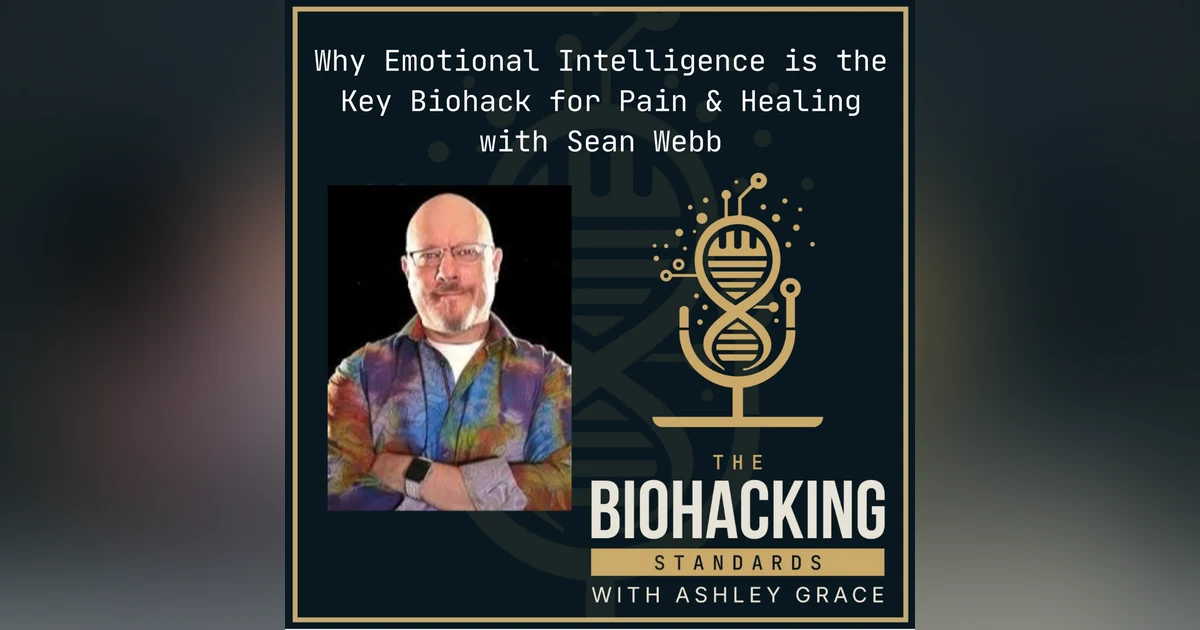
Why Emotional Intelligence is the Key Biohack for Pain and Healing with Sean Webb


 RSS Feed
 Overcast
 Castro
 PocketCasts
 Apple Podcasts
 What if emotional intelligence could do more than improve your relationships? What if understanding how your mind creates emotion could help reduce suffering, support trauma healing, interrupt destructive patterns—and even shape the future of artificial intelligence?
In this episode, consciousness researcher and mind mastery expert Sean Webb explores the connection between emotional intelligence, consciousness, emotional regulation, trauma, addiction recovery, meditation, psychedelics, and AI. Drawing from decades of research and his experience teaching mind mastery techniques to Navy SEALs, Sean reveals a practical framework for understanding why we suffer—and how greater awareness of the mind may help us respond differently.
At the center of Sean’s model is a deceptively simple idea: the brain evolved primarily for survival, not happiness. Your nervous system is constantly evaluating what matters to you, comparing what you expect or prefer with what you perceive to be happening. When reality conflicts with those expectations, an emotional response can follow.
But pain and suffering aren't necessarily the same thing.
Sean explains how rumination, attention, expectation, perception, and attachment can amplify emotional distress long after an event occurs. By learning to observe these processes through meta-awareness, we may be able to interrupt automatic emotional loops and create more space between an experience and our reaction to it.
You’ll discover why changing your attention can change your emotional state, how cognitive reappraisal can transform everyday frustrations, and why asking one simple question—“What else could be true?”—can open the door to a completely different response.
The conversation also goes deeper into trauma, PTSD, and addiction. Sean discusses his view that compulsive behaviors can sometimes reflect unresolved emotional needs and explores how healing may involve helping the thinking mind communicate safety to the feeling mind. He also compares meditation and psychedelics, including psilocybin and ayahuasca, as very different approaches people have used in the pursuit of self-awareness and emotional insight.
Then the discussion moves from the human mind to one of the defining questions of our time:
Should artificial intelligence have emotional intelligence?
Sean argues that the future of AI safety and human-AI interaction may depend not simply on making machines more intelligent, but on designing systems capable of recognizing human emotional context. Large language models can simulate empathy through patterns in human language—but simulation is not the same as human feeling or consciousness.
So what would it mean to intentionally build empathy and compassion into AI?
Sean shares his work around AI systems that model what people care about, fear, value, and identify with—the internal “self map” that can influence emotional responses. The goal is not to create machines that pretend to be human, but to explore whether emotionally informed AI could interact with people more sensitively and reduce harm rather than amplify distress.
In this episode, you’ll learn:
• Why the brain’s survival mechanisms can contribute to emotional suffering
• How expectations and perceptions shape emotional responses
• Why attention and rumination can intensify distress
• How meta-awareness can interrupt automatic emotional loops
• How reappraisal can support emotional regulation
• Sean’s perspective on trauma, PTSD, addiction, and unresolved emotional needs
• The differences between meditation and psychedelic experiences
• Why empathy and compassion could become important elements of AI safety
• How understanding consciousness may change both personal healing and the technology we create
This conversation sits at the intersection of neuroscience, psychology, consciousness research, mental performance, meditation, trauma recovery, psychedelic exploration, emotional intelligence, and artificial intelligence.