
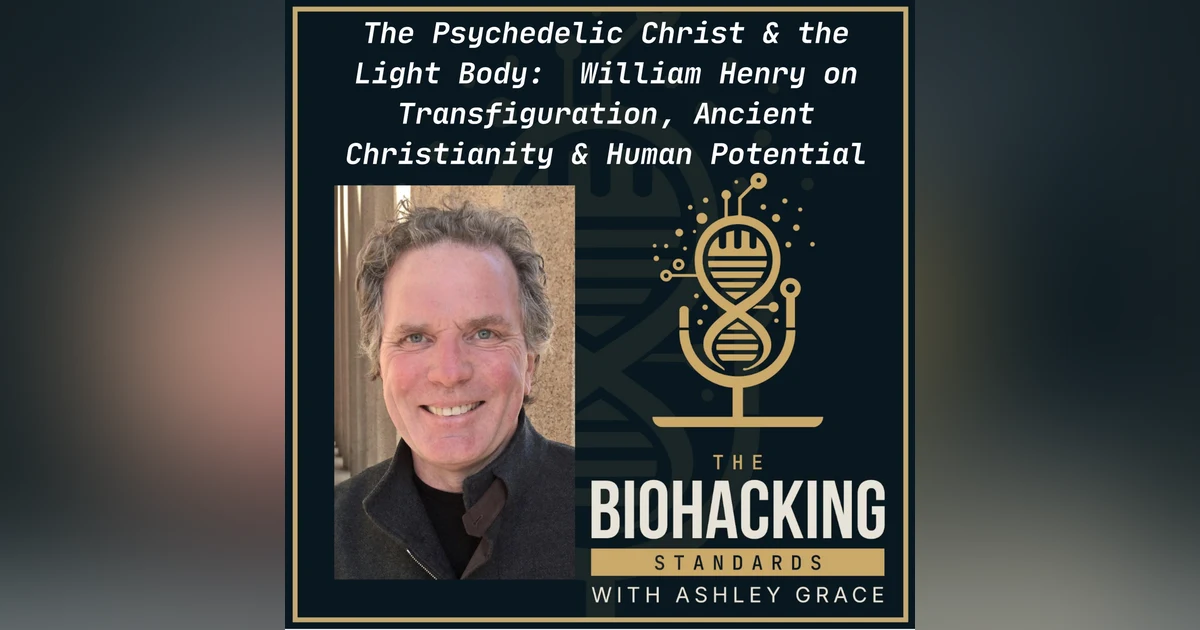
The Psychedelic Christ and the Light Body: William Henry on Transfiguration, Ancient Christianity, & Human Potential


 RSS Feed
 Overcast
 Castro
 PocketCasts
 Apple Podcasts
 What if the original message of Christianity was not simply about belief, but about human transformation?
In this episode of The Biohacking Standards, host Ashley Grace sits down with author and investigative mythologist William Henry for a conversation about The Psychedelic Christ, the light body, transfiguration, ancient Christianity, consciousness, and human potential.
William has spent decades studying Gnostic Christianity, the Dead Sea Scrolls, Egyptian symbolism, Sumerian mythology, Tibetan teachings, and sacred art. Across these traditions, he sees a recurring idea: the human body may be more than a fixed physical form. It may be capable of becoming more luminous, conscious, and spiritually evolved.
William explains what he means by the light body and why terms such as the robe of light, garment of glory, and Tibetan rainbow light body may describe related visions of human transformation. Using the butterfly and chrysalis as a metaphor, he presents the physical body as part of an unfinished process rather than the final limit of what a human being can become.
The conversation turns to William Henry’s interpretation that Jesus came to demonstrate transfiguration rather than establish an institutional religion. William discusses the Essenes, early Christian mysticism, baptism, the Holy Spirit, and biblical descriptions of radiant beings. In his reading, these accounts preserve knowledge about awakening a higher potential within the body and consciousness.
Ashley and William also explore the symbolism of the candle. William describes it as a map of inner illumination, with the candle representing the spinal cord, the wick representing the pineal gland, and the oil representing internal secretions or energies. “Lighting the candle” becomes a metaphor for activating the latent light within a person.
That leads to a discussion about biology and spirituality. Ashley shares his interest in biophotonic emission—the faint light associated with biological processes. Together, they consider whether ancient images of radiant saints, halos, flames, and garments of light offer symbolic parallels to modern questions about mitochondria, meditation, compassion, and consciousness.
The episode then moves into AI, Neuralink, biohacking, and transhumanism. William explains why his position on human enhancement has evolved. Once firmly opposed to transhumanism, he now believes the issue demands a deeper question: What kind of beings are we trying to become? He considers who controls technology, what values guide it, and whether it expands or diminishes human potential.
William repeatedly returns to fear as a barrier to transformation. Ashley brings the discussion into everyday life by sharing a family conflict in which he paused before reacting. That moment changed the emotional energy in the room. For William, this is where the light body becomes practical: transformation appears in the space between impulse and response, in greater compassion, and in the ability to stop repeating old patterns.
This episode explores:
• William Henry’s meaning of the light body and rainbow light body
• The Psychedelic Christ and ancient Christianity
• Jesus, transfiguration, the Essenes, and the robe of light
• The candle, spinal cord, pineal gland, and inner illumination
• Biophotonic emission, mitochondria, and human luminosity
• Gnostic Christianity, Tibetan teachings, Egypt, and Sumer
• AI, Neuralink, transhumanism, and human enhancement
• Moving beyond fear through awareness and conscious response
Whether you are interested in William Henry, The Psychedelic Christ, spiritual awakening, alternative history, consciousness studies, Christian mysticism, ancient wisdom, biohacking, or human evolution, this conversation offers a provocative way to reconsider what transformation may mean.
Listen to explore the possibility that humanity’s oldest spiritual traditions and newest technologies are asking the same essential question: What are we becoming?